Centrul de Artă din Transilvania
  • Home
  • Exhibitions
  • Catalogs

Select your language

  • Magyar (Magyarország) HU
  • Română (RO) RO
  • English (United Kingdom) EN

The exhibition of painters Ilona T. SZŰCS Ilona and László TÓTH

The exhibition of painters Ilona T. SZŰCS Ilona and László TÓTHThe exhibition of painters Ilona T. SZŰCS Ilona and László TÓTHVisiting period: 19th of April – 6th of July 2024 (at the Transylvanian Art Centre)
18th of August – 8th of September 2024 (at the Art Museum of Cluj-Napoca)

Curators: Beáta Bordás PhD and Ágota Portik Blénessy PhD

Opening: The exhibition at the Transylvanian Art Centre was opened on 19th of April 2024 from 6 p.m., by Zoltán Banner art historian and Beáta Bordás, coordinator of the Transylvanian Art Centre.

The exhibition organized at the Art Museum of Cluj-Napoca during the The Hungarian Cultural Days of Cluj was opened on the 18th of August 2024, by Lucian Nastasă-Kovács, manager of the Art Museum of Cluj-Napoca and the curators of the exhibition, art historians Beáta Bordás and Ágota Portik Blénessy.

The present exhibition at the Transylvanian Art Centre is the first to present to the Transylvanian public these two outstanding, closed oeuvres, in more than a hundred works of art by an iconic couple of artists from the 1960’s and 1970’s in Cluj. In this exhibition we aimed to present both oeuvres as fully as possible, showing their phases and presenting the main works of the two artists in relation to each period of creation. At the same time, we have also sought to create a dialogue between the works of the two artists. We hope that this retrospective exhibition and the album, which goes beyond the usual framework of our previous exhibition catalogues and includes forewords by three authors – Zoltán Banner, dr. Ádám Kovács and Beáta Bordás PhD – will be a worthy way of preserving and putting on the agenda the work of these two artists.

Ilona T. SZŰCS (Mediaș, 1930 –Munich, 1990)

She studied at the Târgu Mureș Vocational School of Arts under András Bordi and István Barabás. In 1951, she began her studies in painting at the Nicolae Grigorescu Institute of Fine Arts in Bucharest.From 1952 to 1957 she attended the Ion Andreescu Institute of Fine Arts in Cluj, where she worked under the tutelage of Gábor Miklóssy, Béla Abodi Nagy and Teodor Harșia. In 1955, she got married to her classmate, László Tóth from Satu Mare, their son Tamás was born in 1960.
From 1959 onwards she became a regular participant in the annual provincial and later countyart exhibitions in Cluj-Napoca. In 1965, she received a joint studio with her husband László Tóth and graphic artist Gusztáv Cseh in the Donát district (Vlahuță Street studios), where she also held preparation courses for college admission.
Her works were included in the exhibitions of Romanian artists in Titograd (1968) and Turin (1969). In 1971-72, together with her husband, she created the largescale glass mosaic in the staircase of the Cluj Radio Studio. In 1975 she presented 18 paintings in a solo exhibition at the Korunk Gallery in Cluj-Napoca, while her second solo exhibition (together with her husband) was held posthumously in Szentendre. In 1974 she participated with her husband in the Győr International Artists’ Colony, and in 1981 in the Friendship Creative Art Camp in Lăzarea.

From the 1970s until the early 1980s she worked as a costume designer at the Hungarian State Theatre in Cluj-Napoca, her most important works being in the plays Dumitru Radu Popescu: The Dwarf in the Summer Garden (1974), László Csiki: Old House (1978), László Lőrinczi: The Lover (1982), Sándor Tomcsa: Surgery (1983), Ernő Szép: The Bridegroom (1983). In 1984, Ilona T. Szűcs settled in Munich with her husband, where she worked mainly in decorative art before her early death.

In the 1960s she painted numerous cityscapes of Cluj, consisting of meticulously composed geometric forms. She also made a few portraits, but her interest lay primarily in still lifes assembled from odd, random objects found in and around her studio, which run throughout her oeuvre. These intimate, sometimes depressive, metaphorical still lifes draw on the tools of surrealism and metaphysical painting.

Solo exhibitions:
1975: Korunk Gallery, Cluj Napoca • 1991: Aktív Art Gallery, Szentendre (posthumous, jointly with her husband László Tóth)

Award:
1979: „Cântarea României” [Song to Romania] Festival, second edition, 3rd prize in costume design category

László TÓTH (Satu Mare, 1933 – Wertingen, 2009)

Between 1951 and 1957, he was a student at the painting department of the Ion Andreescu Institute of Fine Arts in Cluj, where his teachers were: Tibor Kádár, Teodor Harșia, Béla Abodi Nagy, and then Gábor Miklóssy. During his university studies, in 1955, he married his classmate, Ilona Szűcs.

After graduation, he began his career as a regular external contributor to the Utunk journal, creating illustrations for short stories and reports published in the magazine between 1957 and 1983. Duringthis period, several other magazines (Korunk, Napsugár, Igaz Szó, etc.) published his drawings, while healso illustrated books and designed book covers. He was a high school teacher for a short time. In the mid-sixties, he got a joint studio with Ilona T. Szűcs and Gusztáv Cseh in the Donát district of Cluj, wherehe and his wife also held preparatory courses for admission to college.

Between 1965 and 1971, he was a set designer of the Hungarian State Theater in Cluj, and later also designed many important sets as an external designer. In the period between 1965 and 1983, he created the set designs for around 25 plays, including A. Miller: After the Fall, Ion Băieșu: Forgiveness, Shakespeare: The Winter’s Tale, I. Madách: The Tragedy of Man, D. R. Popescu: The Garden Dwarf, András Sütő: Star on a Pyre and László Csiki: Old House.In 1971, he became an assistant professor, and later an associate professor, in the department of monumental painting at the Institute of Fine Arts in Cluj-Napoca, teaching drawing, painting, composition and various painting techniques. In 1983, he was appointed head of department, but in 1984 he emigrated to Munich with his wife. From 1986, he became a set painter at the Munich Staatstheater am Gärtnerplatz. After 1992, he began to actively create again and worked as a freelance visual artist until his death in 2009.

Between 1959 and 1983, he exhibited almost every year at the regional and county exhibitions in Cluj, as well as at state exhibitions in Bucharest. A joint exhibition dedicated to the memory of his wife can be considered his first solo show (Szentendre, 1991). Since the end of the 1990s, he participated in some group exhibitions in Germany.

His visionary graphic works and paintings are characterized by a way of seeing close to surrealism, and he brought innovation to Hungarian fine art in Transylvania through the use of collage techniques and new materials. In addition to genre paintings about Cluj, in the 1970s his subjects were his mother, his wife and himself, while he also painted “exploded” still lifes. One of the important themes of his oeuvre is the Negotiation series.

Solo exhibitions:
1991: Aktív Art Gallery, Szentendre (together with his wife, Ilona T. Szűcs) • 2002: Galerie Schröder, Augsburg; “Bálint” Jewish Community House, Budapest • 2003: Korunk Gallery, Cluj-Napoca • 2004: Puskin Community Centre, Tatabánya

Memorial exhibitions:
2014, 2018: Quadro Gallery, Cluj-Napoca

Awards:
1968: First Degree of the Cultural Merit Medal; National Prize of the Association of Fine Artists in the category of set design • 1969: National Theatre Competition, Bucharest, first prize • 1979: „Cântarea României” [Song to Romania] Festival, second edition, Bucharest, stage design category, 3rd prize

Organisers: Town Hall of Sfântu Gheorghe, Transylvanian Art Centre Association – at Cluj-Napoca: Art Museum of Cluj-Napoca, Kincses Kolozsvár Association

Sponsors: Hungarian Government – State Secretary for National Policy, Bethlen Gábor Fund, BitWise IHS Kft.
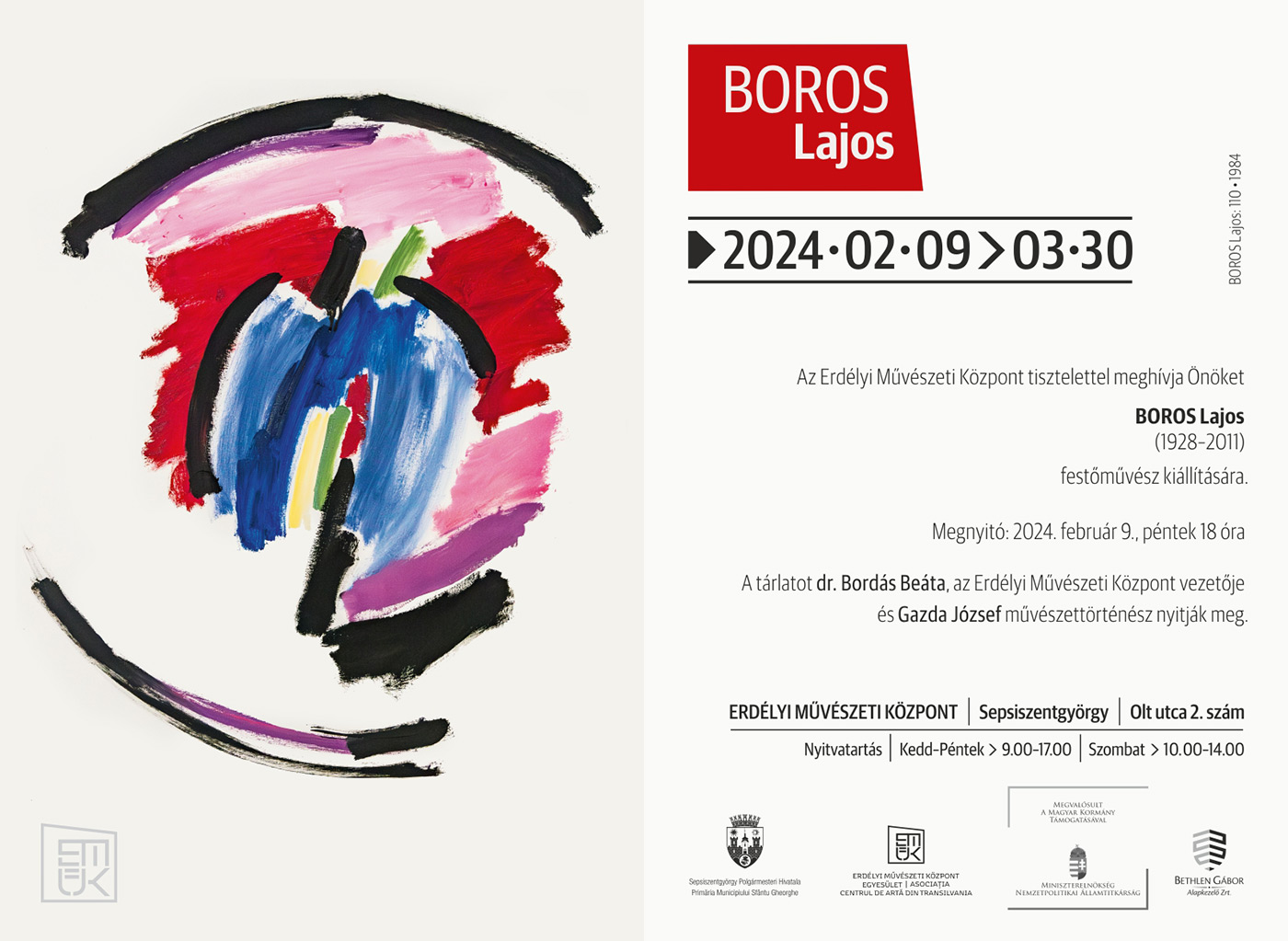
The exhibition of Lajos BOROS painter

Pictură nonfigurativă, dincolo de limitele aleatoriului – Expoziția pictorului Lajos BOROS, un prim reprezentant al picturii abstracte în TransilvaniaVisiting period: 9th of February – 30th of March 2024
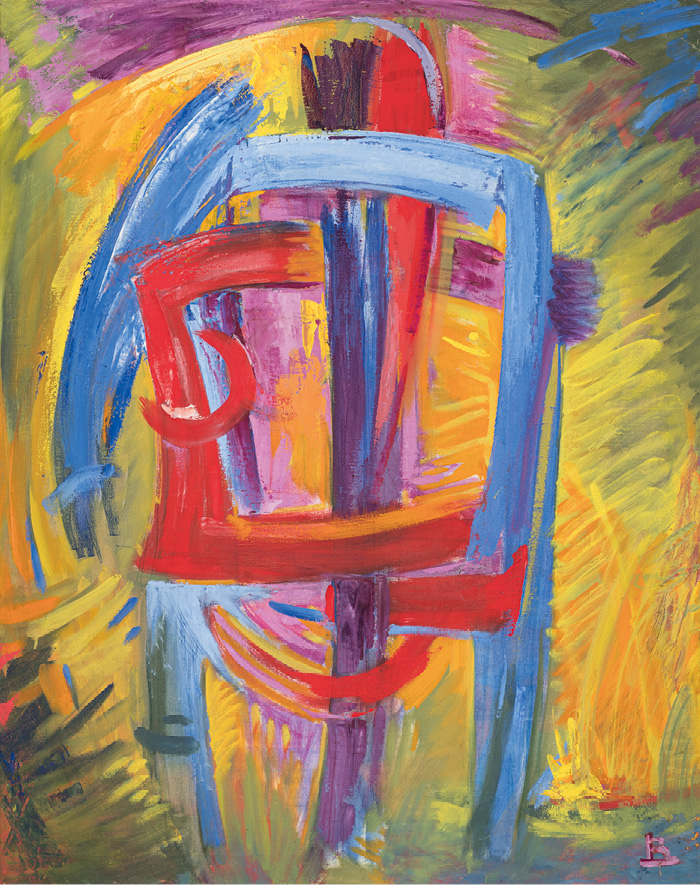
Opening: The exhibition was opened on the 9th of February 2024 starting from 6 p.m., on the third floor of the Transylvanian Art Centre, by Beáta Bordás, coordinator of the Transylvanian Art Centre and József Gazda, art historian.

This exhibition presents the artist’s early works, which are stylized depictions of workers with a restricted colour scale, his first abstract paintings made in Transylvania, and also his paintings made in Germany. In the succession and juxtaposition of these works, the stages of the development of the primordial composition theme, as developed by Lajos Boros, can be clearly traced. Through the creative principle of primordial composition, the artist creates an order in the abstracted formalism of his paintings that strives for speciality.
The exhibition is accompanied by a trilingual catalogue with a foreword by József Gazda.

Lajos BOROS (Sighetu Marmației, 1928 – Wiesbaden, 2011)

Lajos Boros graduated from school in his birthtown, then studied graphic art at the “Ion Andreescu” Fine Arts Institute in Cluj between 1949–1955; in addition to this, he also listened to lectures on art history, pedagogy, psychology and philosophy. In 1953, he married his university colleague, the painter Anna Jakab, and after the graduation they settled down in Baciu (now part of Săcele in Brașov County). Then Lajos Boros met Hans Mattis Teutsch, who had returned to Romania, and whose art became decisive for a lifetime in the development of his own human and artistic habitus; on his advice he began to study the theory of composition and icon painting.

In 1970, Lajos Boros participated in the exhibition of artists from Brașov in Wiesbaden, and claimed the right of asylum. He lived in Wiesbaden, Germany until his death in 2011, where 3 he worked as a teacher while continuously building his distinctive artistic oeuvre.

In Romania, he switched to abstract painting quite early, already in the sixties. In 1965, he began to work on the theory of primordial composition, and after settling in Germany, his first rudimentary paintings of primordial composition were created (1971). In essence, he elaborated and developed this theory and form further and thus he created his unique world.

Solo exhibitions:
1964: Bucharest, Gallery of the Fine Arts Fund (together with Horea Mihai) • 1966, 1969: Brașov, Arta Hall • 1970: Wiesbaden, Museum • 1973: Mainz, Gurlitt Gallery • 1981, 1995: Wiesbaden, Atelier Christa Moering • 1981: Mühlheim, Katholische Akademie die Wolfsburg • 1982: Wiesbaden, Boogie-Woogie Atelier • 1983: München • 1984: Bochum, Glockentrum
Gallery • 1985: Frankfurt am Main • 1986: Wiesbaden, ADL Studio • 1988: Stuttgart, Rudolf Steiner Haus Gallery • 1989: Dornach; Essen, Preutenborbeckshof Gallery • 1990: Budapest, Vigadó; Amsterdam • 1990, 1991, 1994, 1995: Berlin, Kaspar Hauser Forum • 1991: Schopfheim, Grüne Schlange Gallery • 1992: Hannover, Art Forum; Bochum, Glockengarten Gallery • 1993: Heidelberg, Pendel Gallery; Mainz, Waldorfschule Gallery; Saarbrücken, VHS-Zentrum am Schlossplatz • 1997: Kassel, Anthroposophical Center • 1998: Essen • 2004: Wiesbaden, Villa Clementine Gallery

Commemorative exhibitions (selection):
2014: Berlin; Cluj-Napoca, exhibition hall of the Evangelical Church • 2015: Brașov, House of Hope; Baciu; Covasna, László Kádár Gallery • 2016: Sfântu Gheorghe, Outsider Gallery of Iris House • 2017: Budapest, MissionArt Gallery

Organizers: Town Hall of Sfântu Gheorghe, Transylvanian Art Centre Association
Sponsor: Hungarian Government – State Secretary for National Policy, Bethlen Gábor Fund

The exhibition of Tamás VASS graphic artist

Vass Tamas EMUK 2024Visiting period: 16th of February – 5th of April 2024
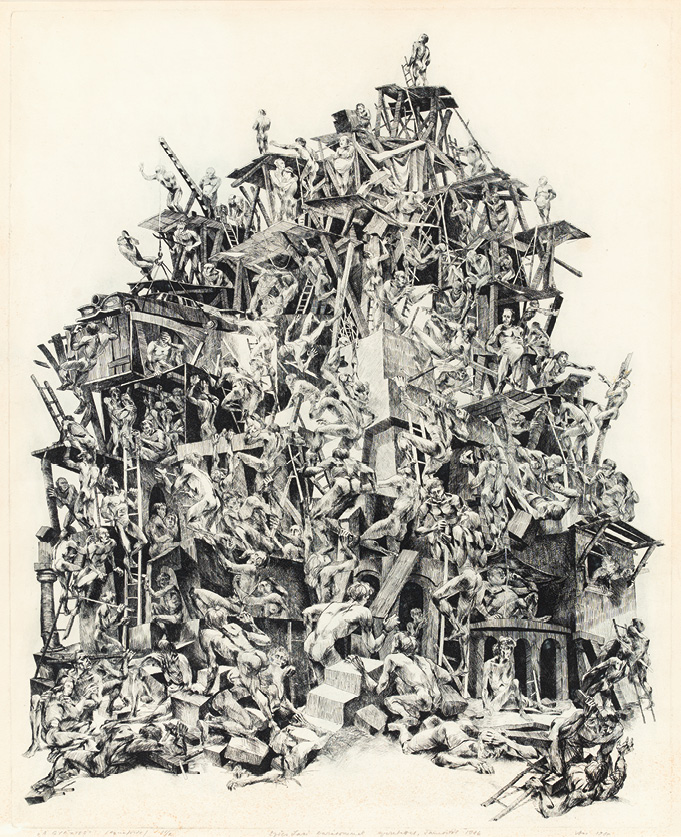
Curators: Ágota Portik Blénessy PhD and dr. Csaba Salat

Opening: The exhibition was opened on the 16th of February 2024, from 6 p.m., on the ground floor of the Transylvanian Art Centre, by Beáta Bordás, coordinator of the Transylvanian Art Centre and the curators, Ágota Portik Blénessy PhD and dr. Csaba Salat.

Loneliness, alienation, and the lack of belonging and truly deep human relationships are evident in Tamás Vass’s notes and drawings. From the second half of the 1970s onwards, dramatic compositions in a mature style and with many shapes dominated his oeuvre, alongside more lyrical cityscapes, nudes or illustrations. This exhibition at the Transylvanian Art Centre offers a wide selection of all these, but will also include autobiographically inspired prints by the artist and some of his etching plates.

We have set out to create an exhibition that will showcase Tamás Vass’s most distinctive works in the greatest depth and detail ever. To this end, we have borrowed some of the most important pieces of his oeuvre, many of them unknown to the public and even to the professionals, from 14 private individuals and a public collection.

The exhibition is accompanied, as usual, by a high-quality trilingual catalogue.

Tamás VASS (Târgu Mureș, 1942–1988)

Tamás Vass continued his studies at the High School of Fine Arts and Music in Târgu Mureș under the mentorship of painters István Barabás and Pál Nagy. The latter had a significant influence on Tamás Vass’ career. In the period 1963–1969, Vass studied at the graphics department of „Ion Andreescu” Institute of Fine Arts from Cluj under the guidance of László Feszt, who played a crucial role in his mastering of various graphic techniques and reproduction procedures at academic level.
The student’s talent was noticed already during his first college year, when he became the external graphic artist of Napsugár children’s magazine, collaborating subsequently in the same capacity also with periodicals like Új Élet, Igaz Szó and Vatra (1972-1987), as well as with publishing houses such as Kriterion, Dacia and Editura Tineretului (1982-1987). His outstanding drawing skills and distinctive artistic vision were highlighted in every county or national exhibition journal, his talent being attested too by the awards he won, however major success and recognition were slow to materialize. During the ever-darkening years of dictatorship, his representative works were excluded from competition by the jury and banned from group exhibitions. This fact – perceived by Vass as artistic failure –, hand in hand with his self-destructive lifestyle led to the gradual deterioration of his health. His untimely death was caused by an internal hemorrhage following a banal fall in his studio on 28 March 1988. But even so, his oeuvre, created in just two decades – prior to his premature death at the age of 45 – exhibits such remarkable richness and variety, that makes it truly unique in the context of Transylvanian visual art.

Solo exhibitions:
1978: Foyer of the National Theater, Târgu Mureș • 1979, 1981: Editorial room of Vatra literary magazine, Târgu Mureș • 1987: Exhibition Hall of Visual Artists’ Association, Târgu Mureș; Foyer of the Hungarian State Theater, Cluj-Napoca

Posthumous exhibitions:
1988: Exhibition Hall of Visual Artists’ Association, Sfântu Gheorghe • 1993: Exhibition Hall of Visual Artists’ Association, Târgu Mureș (with Izolda Macskássy) • 2004: Memorial exhibition organized by the Zsuzsanna Lórántffy Association, Exhibition Hall of Visual Artists’ Association, Târgu Mureș • 2009: Bocskai Hall, Târgu Mureș

Organizers: Town Hall of Sfântu Gheorghe, Transylvanian Art Centre Association
Sponsors: Hungarian Government – State Secretary for National Policy, Bethlen Gábor Fund, S.C. Medisal S.R.L.

Page 2 of 2

  • 1
  • 2
EXHIBITION
Kiállitások – Erdély Művészeti Központ
CATALOGS
Katalógusok – Erdély Művészeti Központ
COLLECTION
Gyűjtemény – Erdély Művészeti Központ

Transylvanian Art Centre

Str. Oltului nr. 2., Sfântu Gheorghe
Jud. Covasna, România

+40 736 350 376
emuksepsi@gmail.com

Shedule:

From Tuesday to Friday: 9 a.m. – 5 p.m.
Saturday: 10 a.m. – 4 p.m.

Visiting the exhibitions is free.

facebook logoinstagram logoyoutube logo

bga logo 1
bga logo 1
bga logo 1

© 2025 – Transylvanian Art Centre

Website Design and Maintenance: Digital Studio